
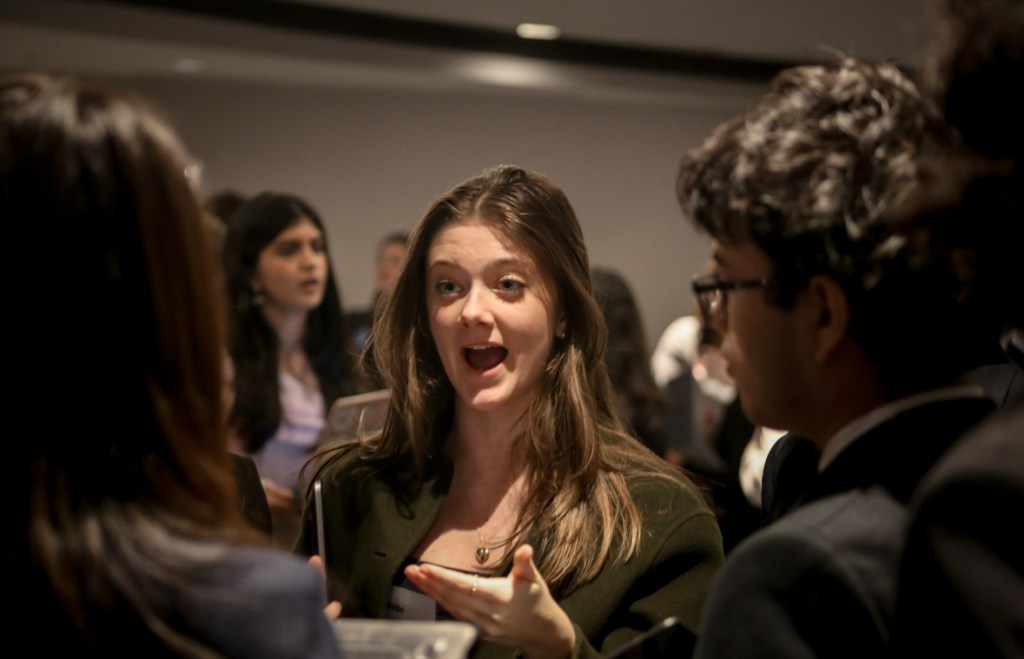
Last weekend, I had the honor and privilege of attending the North American Invitational Model United Nations conference hosted by Georgetown University in Washington, D.C. In the Economic and Social Council, I represented the delegation of Bahrain to discuss the delicate balance between extracting resources for Arctic commerce and the environmental consequences of climate change globally. I walked into the conference expecting a typical model UN simulation; however, I didn’t expect to leave feeling as though I was exactly where I needed to be to understand the complexity and urgency of Arctic policy on a global scale.
Throughout the four days of committee, I saw that the strongest resolutions presented were the ones grounded in scientific research rather than broad generalizations. Proposals included innovative solutions such as using enzyme-based mushroom operations to break down oil spills, adopting net-zero hydrogen and methanol-powered ships to transport goods, and relying on data from the Arctic Report Card to guide future infrastructure decisions. The committee proved to me that when it comes to actual policy-making, credibility comes from evidence, and without a scientific foundation, even very well-written proposals would have struggled to be taken as seriously.
Representing the delegation of Bahrain in this context allowed me to think analytically and adaptively, as the country is a small island nation trying to benefit from the Arctic while ensuring sea levels don’t consume its coastline. Policymaking requires more than advocating for national interests when its impacts are international. It requires establishing evidence, respecting the current capacity of the Arctic Council, and working towards a solution that can be successfully established and funded over the course of the next decade, as well as beyond.
This simulation gave like-minded high school students hands-on experience when it comes to real-world policymaking. Although the Arctic is geographically distant from Bahrain, the lessons I gained about creating foreign policy and encouraging international cooperation by utilizing Bahrain’s location for Arctic trade are universally relevant. This conference truly was an amazing experience for me as well as my passion for understanding policy across borders, and I cannot wait to do it again next year.




Leave a comment